
What Is the Healthiest Hair Extension Method? A Stylist-Approved Guide for Strong, Natural-Looking Results.
Hair extensions have evolved dramatically over the past decade. They are no longer reserved for dramatic transformations or special events; they have become a refined, everyday tool for women who want fuller, healthier-looking hair with integrity. But as extensions become more common, a more important question has emerged quietly in the background:
Which method is actually the healthiest for the natural hair underneath?
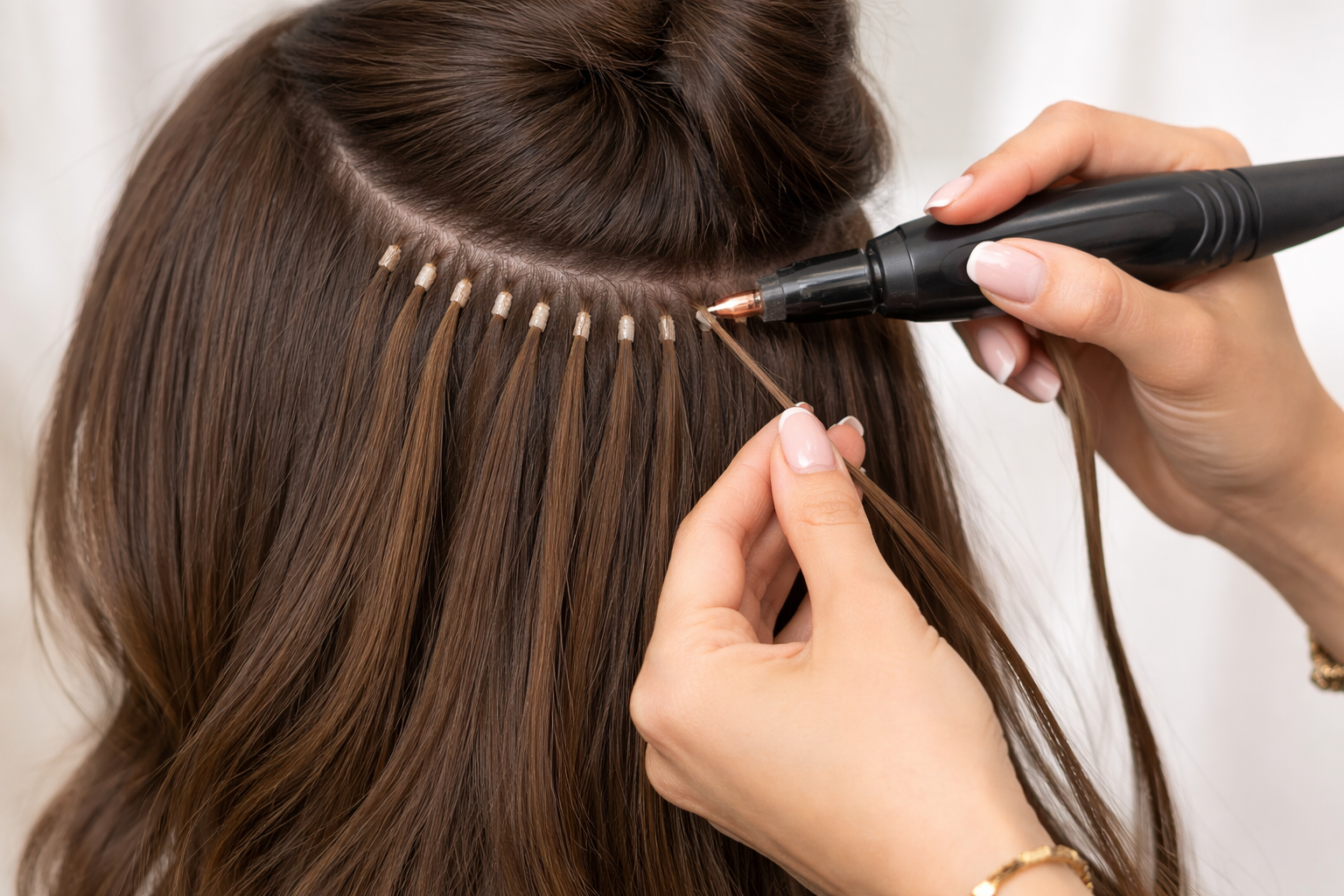
This question matters more today than ever. Women are more informed, more intentional, and more invested in long-term hair wellness. They no longer want shortcuts or high-maintenance solutions, they want something engineered with care. Something that feels invisible. Something that protects the very hair it enhances.
Across the world, stylists, trichologists, and extension educators align on a consistent answer: the healthiest method is not defined by trend or speed. It is defined by customization, precision, and weight control. And among all known systems, keratin fusion, also called keratin bond hair extensions, k-tip extensions, or keratin tips hair extensions, stands at the top when installed correctly.
This guide blends scientific clarity, luxury-brand editorial style, and professional insight to help readers understand why keratin fusion has earned this reputation and how to choose a stylist who prioritizes hair health as deeply as the aesthetic result.
Understanding “Healthy” Hair Extensions: More Than a Buzzword
“Healthy” is one of the most overused words in beauty. But when we talk about the healthiest hair extension method, the definition becomes technical, not emotional. Healthy means:
No excessive tension
No weight imbalance
No friction at the scalp
No bulk that overwhelms the natural hair
No shortcuts in removal
No guessing in placement
Healthy extensions should feel like an extension of the natural hair, not something sitting on top of it. They should move seamlessly, distribute weight evenly, and support the growth cycles happening underneath.
When evaluating any method, professionals look at three core principles:
1.Weight Distribution
If weight is concentrated in a few places, as with wefts or improperly sized tape panels, tension accumulates. Healthy systems distribute weight across many micro-points.
2. Attachment Method
Hardware, beads, and glue each affect the hair differently. Healthy attachment should be flexible, gentle, and easily removable, not rigid or abrasive.
3. Customization Ability
The healthiest method allows the stylist to match bond size to natural density. When customisation isn’t possible, natural hair carries too much strain.
When all three principles align, long-term extension wear becomes not only safe but supportive of natural hair health.
Method Comparison: How Today’s Leading Systems Support or Challenge | Hair Health
Women researching extensions near me or hair extensions in Calgary often discover pages of conflicting information. Each salon seems to champion a different method. This comparison cuts through the noise, focusing solely on structural impact.
1. Tape-In Extensions: Convenient, But Not Always Lightweight
Tape-ins gained popularity for their speed. Lightweight polyurethane panels sandwich a section of hair and lay flat against the scalp.
Pros:
Quick application
Comfortable when used sparingly
Ideal for medium-density hair
Cons:
Panel weight cannot be customized
Adhesive breakdown can cause slippage
Too heavy for fine or thinning hair
Removal requires chemical adhesive release
For clients seeking the healthiest long-term solution, tape-ins are not usually the first recommendation, especially for those with delicate density or hormonal thinning.
2. Weft Extensions (Sew-In, Beaded Rows, Hand-Tied): Beautiful, But Too Heavy for Many
Wefts create volume fast. Rows of hair are applied horizontally using beads or braids.
Pros:
Great for thick, strong hair
Minimal daily maintenance
High impact
Cons:
Weight concentrated in limited anchor points
Tension increases with length
Not suitable for fine, weak, or low-density scalps
Can cause traction if improperly installed
Wefts are stunning but they require the right candidate. They are not the healthiest option for clients with fragile or fine strands.
3. Micro-Rings, Nano-Beads, and Other Link Methods: Adjustable but Hardware-Dependent
Beads attach small extension strands to sections of natural hair.
Pros:
No heat, no adhesive
Adjustable during move-ups
Long-lasting
Cons:
Hardware can rotate and rub
Beads can slip if hair is silky or fine
Not ideal for high-movement areas
Weight cannot be micro-customised enough for the finest hair
These methods work well for some hair types, but for long-term health, they require density and strength.
4. Clip-Ins & Halos: Healthy Only When Used Occasionally
These temporary systems are ideal for one-day styling.
Pros:
Zero commitment
Won’t damage hair when worn sparingly
Cons:
Cannot be worn daily without causing stress
Not designed for sleeping or workouts
Do not create consistent fullness
They are healthy because they are temporary not because they are a structural solution.
The Clear Winner for Hair Health: Keratin Fusion / K-Tip Extensions
When executed correctly, keratin bonded hair extensions embody all three health principles: precise weight distribution, gentle attachment, and full customization.
This is why stylists worldwide, especially in Europe, where long-term extension wear is more common — consider keratin fusion the gold standard.
Here’s why:
1. Micro-Customization Protects Fragile Areas
Each keratin tip is fully customizable. A skilled stylist can split, reshape, or refine the bond to match natural hair density precisely.
Thicker areas receive slightly fuller bonds.
More delicate areas, temples, part lines, front hairline, receive micro-bonds that feel featherlight.
2. Weight Distribution Is Perfectly Even
Because hundreds of individual bonds are placed strategically, the natural hair never carries tension in concentrated areas.
This is why keratin fusion is one of the safest options for:
Fine hair
Hair recovering from stress
Peri-menopausal thinning
Postpartum density changes
Seasonal shedding
The method respects the natural scalp behaviour.
3. Gentle Attachment with Natural Movement
Keratin tips soften with controlled heat and wrap around the natural hair, creating a small, flexible bond that moves as freely as the hair itself.
There is no hardware.
No rigid glue lines.
No adhesive panels.
No friction points.
The structure is minimal, elegant, and secure.
4. Seamless Integration: The Most Invisible Method
Because keratin fusion involves strand-by-strand application, it blends flawlessly into all textures and densities. This is why clients searching for the most natural-looking extensions near me consistently end up choosing k-tip extensions.
When placed properly, they are virtually undetectable in:
High ponytails
Half-up styles
Braids
Wind or movement
This invisibility makes the method not only healthy, but also aesthetically superior.
5. Clean Removal Protects Natural Hair
Keratin bonds are removed with a professional solvent that breaks down the bond cleanly. The natural hair slides free without cutting, pulling, or scraping — a major advantage over adhesive-based systems.
Healthy removal = healthy regrowth.
6. Ideal for Long-Term Wear
Many clients wear keratin fusion consistently for years without damage, something far less common with heavy wefts or oversized tape panels. The method supports consistent, stable volume without compromising the integrity of the natural hair.
Why Technique Matters Even More Than Method:
The method matters — but the stylist matters more.
Two people can receive the same keratin bond extensions yet have entirely different experiences based on:
Sectioning technique
Bond sizing
Density mapping
Weight control
Removal timing
Scalp sensitivity analysis
Aftercare education
Healthy extensions require intention at every stage.
At Confide Hair, the process includes:
Scalp & Hair Strength Assessment
Understanding elasticity, density shifts, follicle sensitivity, and areas needing micro-bonds.
Custom Bond Creation
Hand-made keratin tips designed for your natural hair weight.
Placement Mapping
Patterns designed around styling habits, parting, and natural fall.
Precision Installation
Each bond is placed at a tension and angle that supports healthy growth.
Education & Aftercare
Clients are taught brushing, washing, drying, and maintenance techniques that protect both the extensions and the natural hair. Healthy extensions are not an accident. They are engineered.
What Makes Keratin Fusion the Healthiest Choice for Different Hair Types
Fine or Delicate Hair
Micro-bonds prevent strain and support gentle enhancement.
Medium Density Hair
Custom sizing creates seamless fullness without bulk.
Thick Hair
Bonds can be sized up for balanced volume that still lies naturally.
Curly or Wavy Hair
Strand-by-strand placement mirrors natural curl patterns.
Oily or Soft Hair
Keratin fusion avoids slipping issues common with tapes or beads.
Short or Blunt Bobs
Strategic mapping smooths transitions and hides shorter edges.
The method adapts — profoundly — to your needs.
Hair Extensions Cost vs. Hair Extensions Value
Clients researching hair extensions cost, extensions hair price, or price for hair extensions often compare methods by number alone. But cost becomes irrelevant without understanding value.
Keratin fusion offers long-term value through:
Longer wear time
Better blend
Less tension
Healthier regrowth
Lower risk of damage
More versatility in styling
What you pay for is not the hair itself — it’s the protection of the hair you already have.
How to Know If Your Extensions Are Healthy
Healthy extensions should feel like nothing at all.
If you experience any of the following, something is wrong:
Persistent pain
Tugging during brushing
Visible tension at the root
Slipping within weeks
Heavy, bulky feeling
Excess shedding with bulbs attached
Matting at the connection point
Healthy extensions should support the hair, not challenge it.
Why Keratin Fusion Is the Best Choice for Anyone Prioritising Hair Health
Keratin fusion stands out not because of hype, but because of design. It combines:
Lightweight structure
Customizable sizing
Gentle attachment
Perfect weight distribution
Clean removal
Natural movement
For clients searching for the healthiest hair extension method, this approach aligns science, beauty, and long-term wellness.
It is discreet.
It is modern.
It is engineered for protection.
And when performed by an expert, it is the safest method available today.
Explore Healthy, Subtle Support at Confide Hair Extensions
Contact or Book With Confide Hair Calgary
If you’re navigating peri-menopausal hair thinning and want a solution that protects the health of your natural hair while restoring soft, believable fullness, a consultation at Confide Hair is the ideal first step.
Whether you’re exploring keratin bond extensions, precision volume enhancement, or long-term density strategies, you’ll receive guidance grounded in expertise, respect, and thoughtful design.
Book your consultation in Calgary today and rediscover hair that feels like you, strong, natural, and beautifully supported.
